
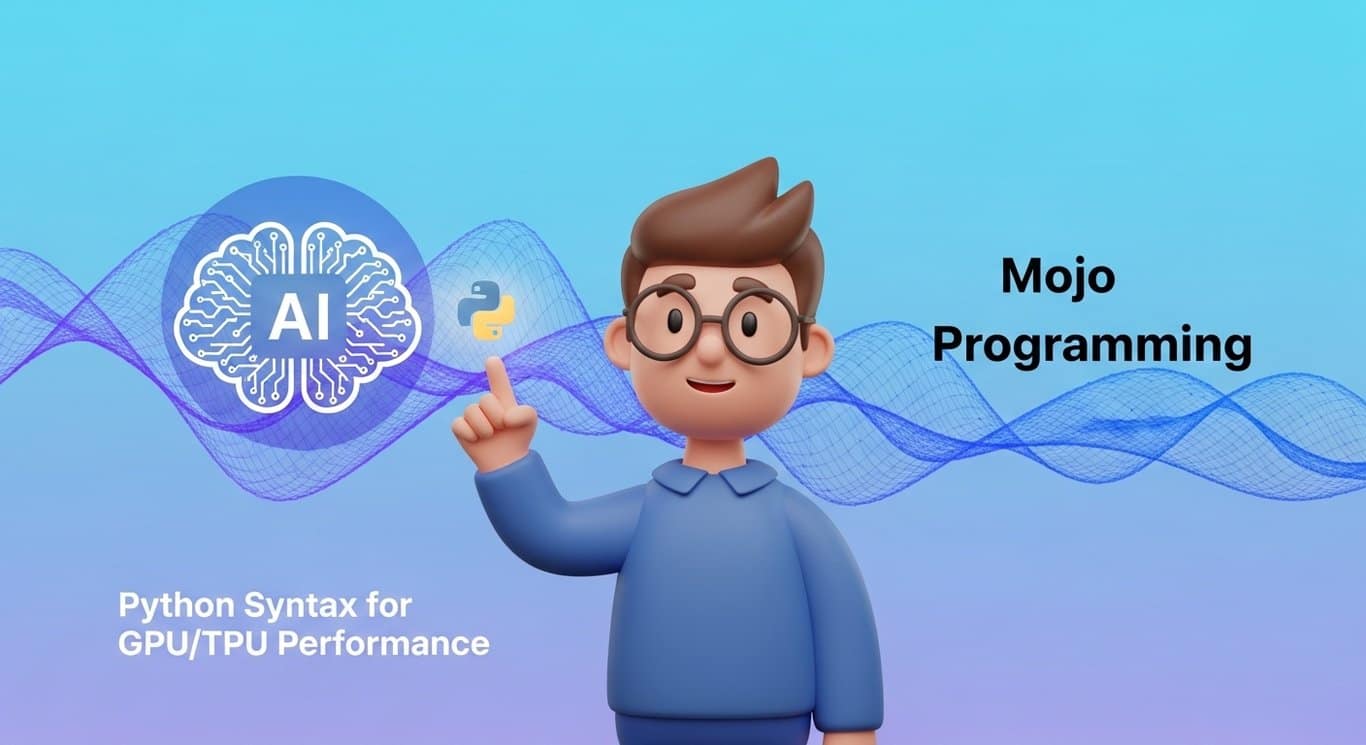
A lot of AI teams hit the same wall: Python gets a model working quickly, but the last stretch of performance still slips into C++, CUDA, or hardware-specific toolchains. Mojo programming AI acceleration is getting attention because it tries to narrow that gap. Mojo is positioned as a Pythonic systems language for high-performance AI infrastructure, with official support and tutorials centered on CPUs and GPUs, plus a broader long-term vision for heterogeneous accelerators.
Table of Contents
Why Mojo programming AI acceleration is getting attention
How Mojo works for GPU and accelerator-heavy AI workloads
Integrating Mojo with Python ML workflows
Benchmarking Mojo programming AI acceleration realistically
What I’ve learned from real usage
Things blogs don’t usually mention
Who should NOT use this
Ecosystem, tooling, and the 2026 outlook
Where to start next
Why Mojo programming AI acceleration is getting attention
Mojo matters because it targets a very specific pain point in AI engineering: Python is productive, but pure Python is not where you want to live when you are tuning kernels, controlling memory movement, or trying to squeeze predictable latency from GPU inference. Modular describes Mojo as a language that combines Python-style syntax with systems programming capabilities, and its public materials increasingly frame it as a way to write performance-oriented code across CPUs and GPUs without committing to one vendor API from day one.
What Mojo is, in practical terms
For a Python developer, Mojo feels familiar on the surface, but it is not simply “Python made faster.” It adds stronger typing, compile-time features, low-level control, direct access to SIMD and GPU-oriented primitives, and a packaging/compilation model built for executable performance rather than interpreter convenience. The official vision also explains that Mojo is designed as syntactic sugar over MLIR-oriented compiler technology, which is one reason hardware targeting is central to the language rather than an afterthought.
Why hardware acceleration changes the conversation
When people compare Mojo vs Python performance, the useful question is not whether a simple loop can run faster. That part is almost expected. The real question is whether a Python-like AI programming language can help teams move performance-critical pieces closer to the hardware without exploding complexity. In practice, that matters most for tensor kernels, fused operators, quantized inference paths, memory-bound preprocessing, and custom graph operations that standard frameworks do not optimize well for your workload. MAX’s custom-op path is a good example: write the surrounding application in Python, then drop into Mojo where hardware-specific speed actually matters.
How Mojo works for GPU and accelerator-heavy AI workloads
The easiest way to understand Mojo for AI hardware is to treat it as a bridge between framework-level productivity and kernel-level control. The public docs are strongest on CPU and GPU programming today, with dedicated GPU tutorials, GPU fundamentals, and low-level APIs for thread organization, memory behavior, and device dispatch.
GPU acceleration without dropping straight into CUDA
This is where the language becomes interesting for machine learning hardware optimization. Modular’s current material emphasizes native support across multiple GPU targets, including NVIDIA and AMD, and recent releases also expanded Apple silicon GPU coverage. That does not mean every workload becomes portable automatically; it means the language is explicitly trying to expose GPU programming as a first-class activity instead of forcing teams to treat it as a separate universe.
For ML engineers, the practical benefit is not “replace PyTorch with Mojo tomorrow.” It is more selective. You keep the high-level training or serving stack where it already works, then use Mojo where layout, fusion, tiling, or custom execution paths dominate latency. A realistic example is a bespoke attention-adjacent kernel or post-processing stage that runs millions of times per day. If a Python implementation costs 2.5 milliseconds and a hardware-tuned version cuts that to 0.6 milliseconds, the gain is meaningful. That number is only an illustration, not an official benchmark, but it reflects the kind of delta that matters in production inference. MAX’s design and Modular’s benchmarking guidance both push in that direction: measure the hot path, not the marketing claim.
Where TPU programming Mojo stands today
TPU programming Mojo is best understood as part of the language vision, not yet the most mature public developer story. Modular’s broader language vision and earlier architectural writing mention TPUs as a target class of hardware, but the public tutorials, examples, and day-to-day documentation are far more concrete around CPU and GPU workflows. For technical decision-makers, that means Mojo is worth tracking if your long-term goal is portable AI computation optimization across different accelerators, but it is safer to treat TPU use today as a strategic direction rather than a drop-in replacement for mature TPU-first stacks.
Integrating Mojo with Python ML workflows
This is one of Mojo’s stronger practical advantages. The official docs support both calling Python from Mojo and calling Mojo from Python. That matters because most AI teams do not need a new world; they need a way to isolate expensive code paths while keeping NumPy, PyTorch, TensorFlow-adjacent utilities, notebooks, and existing orchestration intact.
Calling Python from Mojo
Mojo can import Python modules directly through its Python interop path, and the docs show NumPy as a straightforward example. This lowers migration risk because you can keep proven Python components in place while rewriting only the hot sections in a high-performance Python alternative. That is a more credible adoption path than a full rewrite.
Calling Mojo from Python
The reverse path matters even more for production engineering. The official documentation now covers importing Mojo modules into Python, which makes it practical to expose a tuned routine to an existing ML service, research codebase, or inference API without changing the whole application boundary. For many teams, that is the most realistic “Mojo AI framework” pattern: Python remains the control plane; Mojo becomes the acceleration layer.
A realistic workflow
A sensible workflow is to prototype in Python, profile the real bottleneck, move only the bottleneck into Mojo, validate numerical equivalence, and then benchmark again under production-like batch sizes and device conditions. That is especially useful for AI model inference acceleration on edge or cost-sensitive infrastructure, where shaving memory movement or kernel launch overhead can matter more than raw FLOPS headlines. The official benchmarking tools in Mojo are built for repeated measurement with warmup and batch handling, which is exactly what you want when noisy measurements can hide the real picture.
Benchmarking Mojo programming AI acceleration realistically
This is where a lot of writing on Mojo becomes sloppy. Kernel-level gains can be large, but end-to-end gains are often smaller because full training and serving pipelines include Python orchestration, framework overhead, data loading, communication, caching, and device utilization issues that a faster kernel alone will not fix. Modular’s own benchmarking guidance stresses methodology for a reason: warmup, variance, representative workloads, and honest baselines matter.
For researchers and practitioners, the most honest comparison is not “Mojo vs Python” as a slogan. It is “this specific operation in Mojo vs the current implementation under the same device, tensor shapes, precision mode, and memory constraints.” If the workload is already fused well inside a mature framework, Mojo may not move the needle much. If the workload has custom structure, awkward memory access, or repeated pre/post-processing that frameworks do not optimize well, Mojo has a much better case.
What I’ve learned from real usage
Mojo makes the most sense when you treat it as a precision tool, not an ideology. Teams coming from Python tend to overvalue syntax familiarity and undervalue the systems discipline that performance work still requires. You still need to think about data layout, ownership, transfer boundaries, vectorization, batching, and device-specific behavior. Mojo reduces the cognitive jump compared with handwritten CUDA or sprawling C++ templates, but it does not repeal the physics of hardware. That is also why the language is more compelling for infrastructure-minded ML engineers than for casual notebook users.
The other lesson is that interoperability is not a side feature; it is the adoption story. A language that asks an AI team to abandon Python’s ecosystem usually loses. A language that lets the team keep Python and surgically optimize the expensive 5 percent has a real chance. Mojo’s Python interop and MAX custom-op flow are the practical reasons it belongs in serious evaluation.
Things blogs don’t usually mention
Early adoption has a tax. Mojo is moving quickly, the changelog is active, and Modular has been explicit that the roadmap is still evolving toward 1.0 in 2026. That is exciting for innovators and uncomfortable for conservative platform teams. You should expect APIs, compiler behavior, and best practices to keep improving, but that also means internal standards, onboarding material, and long-term maintenance need more attention than they would for older languages.
Another detail people skip: the public story is uneven across hardware. GPU acceleration Python alternative is the strongest near-term pitch. TPU programming Mojo is more forward-looking. If your organization already runs stable TPU-heavy training or inference with established tooling, the burden of proof is higher. Mojo may still become relevant, but not because a headline says “portable accelerator language.” It becomes relevant when it improves one concrete bottleneck you can measure.
Before you commit engineering time, check four things:
whether your bottleneck is really in a custom compute path rather than framework orchestration
whether the affected code is isolated enough to rewrite safely
whether your target hardware is well covered by the public tooling you need today
whether your team can maintain a performance-oriented code path after the first benchmark win
Who should NOT use this
Mojo is a poor fit for teams that do not yet know where their performance problem is. If your profiling is weak, your data pipeline is the real bottleneck, or your model choice is still unstable week to week, adding a new language will probably create more complexity than value. The same caution applies to teams that need broad, boring, long-term standardization right now. Mojo is promising, but it is still a fast-evolving platform, not a settled commodity toolchain.
It is also not the first thing I would recommend to a researcher whose work lives entirely inside mature framework primitives. If PyTorch, JAX, TensorFlow, or vendor libraries already cover the workload efficiently, you may get more value from model changes, precision changes, better batching, quantization, or serving architecture work than from writing custom Mojo. Mojo becomes compelling when the standard path stops being enough.
Ecosystem, tooling, and the 2026 outlook
The ecosystem is getting more credible. Mojo can be installed as a Python or Conda package, and the tooling now includes a language server, REPL, formatter, debugger, and a VS Code extension with syntax highlighting, completion, and debugging support. The standard library is open source, MAX AI kernels are open source, and Modular has said the compiler is expected to follow with the 1.0 milestone path in 2026. That combination matters because high-performance languages without usable tooling rarely survive beyond demos.
For AI researchers, ML engineers, and technical buyers, the practical outlook is straightforward. Mojo is already worth watching if you care about high-performance Python, kernel development, custom ops, or cross-hardware AI infrastructure. It is less convincing as an all-purpose replacement for the Python ecosystem, and it does not need to be. Its strongest role today is as a performance layer that lets Python-heavy teams reach deeper into machine learning hardware optimization without immediately becoming a CUDA shop.
Where to start next
If you are evaluating Mojo seriously, start with one narrow workload: a custom kernel, a repeated preprocessing stage, a quantized inference path, or a graph op that is expensive enough to matter and isolated enough to test safely. Keep the surrounding Python stack intact, verify correctness before speed, and benchmark under realistic tensor shapes and device conditions. That is the right way to judge whether Mojo programming AI acceleration is useful for your environment or just interesting in theory.
Mojo’s real promise is not that it makes hardware complexity disappear. It is that it may let more AI teams engage with that complexity at the right layer, with less boilerplate and better portability than the old stack demanded. For GPU-focused workloads, that promise is already concrete enough to experiment with. For TPU-heavy plans, it is a direction worth tracking carefully, with expectations set by current public support rather than future vision.