
Building an AI Calling Platform: Full-Stack SaaS
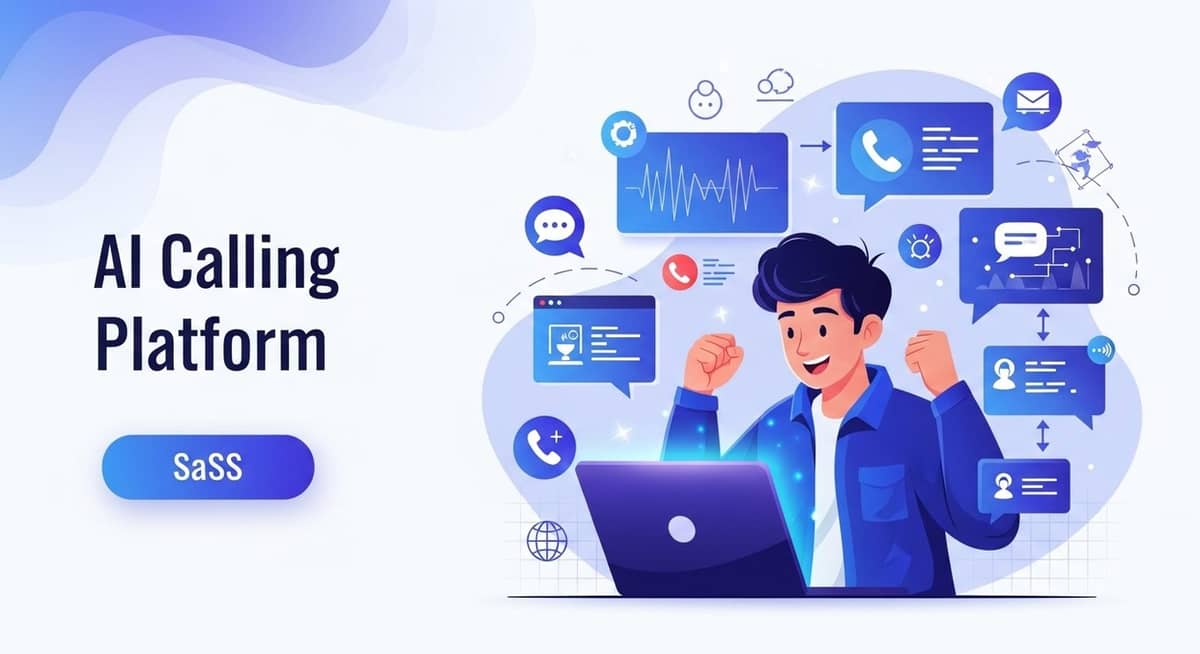
Most people picture an AI calling platform as a voice model connected to a phone number. That is usually where the demo starts, and almost never where the product ends. The real build is a layered SaaS system that has to manage AI telephony, call routing, booking logic, tenant isolation, billing, custom domains, webhook security, and country-specific number compliance without becoming fragile after the first serious customer onboarding. The gap between “it made a call” and “a business can run on this” is where most projects either become real products or stall out.
Table of Contents
Why an AI calling platform is harder than it looks
Designing the AI calling platform before you write code
Building the voice, voice cloning, and AI telephony layer
Automated appointment booking that does not fall apart at scale
SaaS payment integration and pricing design for an AI calling platform
White-label SaaS, custom domains, and cloud DNS API realities
Security, compliance, and operational guardrails
What I’ve learned from real usage
Things blogs don’t usually mention
Who should NOT use this
Frequently asked questions (FAQ)
Where I would start if I were building today
Why an AI calling platform is harder than it looks
The first mistake is treating voice as the product. Voice is only one layer. A production-grade platform usually has at least five distinct systems: speech and agent orchestration, telephony connectivity, workflow execution, business logic, and SaaS operations. ElevenLabs, for example, supports conversational agents, SIP trunking, native Twilio integration, outbound batch calls, analytics, testing, and privacy controls. Twilio and Telnyx, on the carrier side, sit closer to PSTN connectivity, number inventory, SIP, and routing. Google Calendar or Cal.com handle scheduling. Stripe handles recurring and usage-based commercial logic. Cloudflare or a similar provider handles custom domain onboarding for white-label customers. None of those layers solve the other layers for you.
That matters because your earliest architecture choices determine whether your platform stays flexible or becomes trapped inside one vendor’s assumptions. If you hard-wire prompt logic into the telephony layer, changing providers becomes painful. If you couple billing directly to carrier events, pricing experiments become risky. If you let each white-label customer have its own one-off routing rules with no tenant model, support costs grow faster than revenue. The build becomes less about “can the AI speak naturally?” and more about “can the whole system survive unpredictable real-world traffic?”
A second mistake is assuming the hard part is getting calls connected. That is often the easiest milestone. The harder problems show up after connection: handoff to a human, retries after no answer, voicemail detection, appointment conflicts, timezone drift, duplicate bookings, transcript retention, webhook replay handling, and invoice disputes when a customer says the bot should not have billed for a failed interaction. Those are SaaS product problems wearing a telephony costume.
Designing the AI calling platform before you write code
A serious AI calling platform needs a narrower first use case than most founders initially want. “AI calls for any business” sounds large, but it hides different operational requirements. Automated appointment booking for clinics is not the same as lead qualification for agencies. Debt collection, customer support callbacks, missed-call follow-up, and multilingual front-desk automation all have different compliance exposure, fallback rules, and success definitions. Narrowing the first use case makes your prompt design, call automation, and reporting more coherent.
The right framing is to define the call as a business transaction, not as a conversation. Ask what state change the call should create. Should it confirm a booking, collect structured intake data, escalate to a human, or qualify a lead? If you cannot describe the desired state transition clearly, your agent design will drift into generic “helpful assistant” behavior, which sounds impressive in demos and performs poorly in production.
Start with the workflow, not the model
The model does not own the business process. Your application does. That means you should define the workflow as a state machine before you finalize prompts. A practical first version often needs states such as initiated, ringing, connected, authenticating, task-in-progress, escalated, completed, failed, and review-required. That structure makes it possible to calculate real outcomes, retrigger safely, and keep humans in the loop when confidence is low.
Decide where determinism matters
Some parts of a call should be flexible. Others should be rigid. Natural dialogue can handle greeting style, minor clarifications, and tone adaptation. But identity verification, booking payloads, date parsing, payment handoff, and escalation rules usually need deterministic validation. This is where many early products go wrong: they let a conversational layer improvise around fields that should be schema-bound.
A good rule is simple. If a mistake creates support work, money leakage, or compliance risk, keep that part structured.
Design for handoff on day one
ElevenLabs documents transfer support for Twilio and SIP trunk numbers, including conference, blind, and SIP REFER transfer modes, but the implementation details differ depending on how the number is connected. Warm transfer behavior is not identical across paths. That is a reminder that human escalation is not just a UI button; it is a carrier-and-connection decision you need to model early.
Building the voice, voice cloning, and AI telephony layer
This is the part most people think of first, and it still deserves careful attention. Voice is the interface people will judge instantly. The problem is that “good enough in a quiet demo” is not good enough on a real phone network with background noise, lag, interruptions, and caller skepticism.
The voice layer: where the ElevenLabs API helps and where it does not
On the voice side, the ElevenLabs API and ElevenLabs Agents stack give you a fast way to move from text generation to spoken interaction. Their documentation shows support for SIP trunk connectivity, native Twilio integration, outbound batch calls, analytics, experiments, and configurable retention controls. Their SIP trunking docs also state support for both inbound and outbound calls and mention encrypted TLS transport and media encryption. That makes ElevenLabs a reasonable AI voice layer when you want to focus on the agent experience instead of building speech infrastructure from scratch.
What it does not do is eliminate the need for telephony design. You still have to decide where numbers live, how calls enter the system, how failures are retried, and how you will support customers who want their existing carrier relationships preserved.
Voice cloning is useful, but it raises the bar
Voice cloning gets overused in marketing and under-scoped in product design. In practice, it helps most when a business already has a recognizable voice identity and a legitimate reason to preserve it, such as continuity for a branded receptionist or consistent outbound messaging. It is less useful when the real problem is call flow design, bad prompts, or poor latency.
ElevenLabs distinguishes between Instant Voice Cloning and Professional Voice Cloning. Their docs say instant cloning requires the user to confirm they have the right and consent to clone the voice, while professional cloning includes a verification step so the voice owner can prove permission before training begins. Their privacy policy also explains that voice data may be processed for verification, anti-fraud, and misuse prevention. That means voice cloning is not just a UI feature toggle. It is a consent, verification, and governance workflow.
It helps when the caller already expects a known voice, when consistency matters across campaigns, or when the customer understands the legal and brand implications.
It is a distraction when the business has not yet validated call outcomes, when scripts change often, or when a standard high-quality synthetic voice would do the job with less operational and reputational risk.
Twilio integration, Telnyx trunks, and BYOC (Bring Your Own Carrier)
Twilio and Telnyx both solve real problems, but they solve different problems especially well. Twilio’s BYOC Trunking docs emphasize that you can connect an existing PSTN carrier to Twilio and keep your carrier plus your phone number inventory while still building on Twilio Voice or SIP Trunking. Twilio’s SIP docs also describe routing calls between existing SIP infrastructure, PSTN, browsers, and mobile apps. That makes Twilio strong when you want application control and a broad programmable ecosystem.
Telnyx is attractive when you want a carrier-centric model, number buying, SIP infrastructure, and more direct telecom control. ElevenLabs also documents direct Telnyx SIP trunk integration for connecting existing Telnyx numbers and infrastructure into its agent layer. If your roadmap includes BYOC (Bring Your Own Carrier), white-label resale, or multi-tenant number assignment, Telnyx can fit naturally into that architecture.
The practical decision is not “Twilio or Telnyx forever.” It is whether your first version needs a managed communications API, carrier flexibility, or both. A lot of teams start with one provider, then later split responsibilities: one layer for application logic, another for number ownership and routing.
Automated appointment booking that does not fall apart at scale
Automated appointment booking looks simple until you have to sync real calendars across multiple users, time zones, and retry conditions. A good voice agent can gather intent, but the booking system still needs to do deterministic work: find availability, lock a slot, create a calendar record, notify attendees, and avoid duplicates.
Google Calendar’s API supports creating events through events.insert(), requires start and end fields, and allows you to set your own event ID. The docs explicitly note that choosing your own event ID can help keep your local database in sync and prevent duplicate event creation if an operation partially succeeds. The Calendar API also supports push notifications so your application can watch resources and reduce wasteful polling. Those details matter because duplicate bookings and stale availability are among the first things that erode trust in an automated scheduling workflow.
Cal.com is useful when you want more scheduling infrastructure out of the box or you are building a platform experience for multiple users. Its booking API documentation shows support for API keys, OAuth access tokens, and platform-specific headers, which is relevant if you want a marketplace-like scheduling layer inside a broader SaaS product.
The real booking problems are operational
The hard parts are rarely “create the event.” The hard parts are slot contention, user reschedules during the same minute, business-hour exceptions, locale-specific date understanding, and missed callbacks from third-party systems. If the voice agent says “I have booked you for Tuesday at 3:00” before the booking write is fully confirmed, you will eventually create customer-facing errors that support has to unwind manually.
Booking writes should have their own idempotency layer separate from call IDs. A single call can legitimately produce multiple booking attempts if the customer changes time preferences mid-conversation. Your system needs a durable way to tell the difference between “new booking,” “reschedule,” and “replayed webhook.”
Founders often obsess over accent realism and overlook time zones. In production, timezone and daylight-saving errors destroy more trust than slightly robotic phrasing.
SaaS payment integration and pricing design for an AI calling platform
A working AI product without a durable revenue model is still a prototype. The commercial side of an AI calling platform is not just charging for access. It is matching your pricing to the way value and cost actually happen.
Stripe Billing supports recurring subscriptions, usage-based billing, and more complex pricing structures. Stripe’s current billing documentation also describes pricing plans that can combine metered components, fixed license fees, and service actions such as recurring credit grants, with customer subscription flows available through Checkout Sessions or direct API methods. That is relevant because AI telephony products rarely fit a single flat-rate plan once real usage variation appears.
Why flat pricing breaks early
If you charge a flat monthly fee too soon, heavy users will absorb far more compute, carrier, and support cost than light users. If you charge only per minute, customers may resist onboarding because monthly cost feels unpredictable. In practice, many platforms end up with a hybrid model: a base subscription for seats, features, or environments, then usage charges for minutes, successful transactions, or bundled credits.
Charge for the unit customers understand
Founders often want to bill for what the infrastructure measures. Customers want to pay for what they recognize. Minutes are easy to meter but not always the best commercial story. Some businesses care about booked appointments, transferred calls, or qualified leads more than raw call duration. That does not mean you should always bill per outcome. It means your internal cost model and external pricing model do not have to be identical.
SaaS payment integration is also an accounting design problem
Once you support trials, credits, top-ups, overages, reseller markups, or white-label billing, your schema matters as much as your payment UI. Stripe’s webhook docs recommend verifying events using the Stripe-Signature header and the endpoint secret, which is a reminder that billing is event-driven infrastructure, not just checkout pages. If your entitlement system trusts unsigned events or mutates customer state before verification, you will eventually create reconciliation issues.
White-label SaaS, custom domains, and cloud DNS API realities
White-label SaaS sounds straightforward until you offer branded domains. Then you inherit DNS, TLS, ownership validation, and customer onboarding friction.
Cloudflare for SaaS supports adding customer-owned subdomains and vanity domains to your zone as custom hostnames. Their docs explain that you need a fallback origin, can optionally define a CNAME target for customer routing, and must validate hostname ownership before traffic is proxied. They also note that custom hostnames using another CDN are not compatible in certain validation scenarios, and that customers generally need to create a CNAME pointing at your target to finish setup. That means a cloud DNS API can automate part of onboarding, but not the whole experience. Certificate issuance, validation timing, DNS propagation, and customer DNS access are still real dependencies.
This is where many white-label SaaS products underestimate support load. “One-click domain setup” is only one click for customers whose DNS provider, ownership path, and validation timing all line up cleanly. The rest need stateful onboarding with useful status messages such as pending validation, certificate provisioning, DNS not detected, or active.
A cloud DNS API is still valuable. It lets you automate records where you control the zone, build better progress tracking, and reduce manual support time. But it should be framed as an orchestration layer, not a magic button.
Security, compliance, and operational guardrails
Telephony platforms fail quietly when they skip operational basics. Webhooks are the backbone of call status, billing events, and calendar changes. Twilio’s webhook docs explain that voice requests are sent to your application in real time and that your application responds with TwiML for Programmable Voice. Twilio’s security docs also say you should use HTTPS and verify the X-Twilio-Signature header on inbound requests. Stripe has parallel guidance for verifying webhook events via Stripe-Signature. Build those controls before scale, not after an incident.
Number compliance is another place where technical teams get surprised. Twilio’s regulatory guidance states that phone number compliance is required because numbers are national resources, and that regulators often require end-user identity and supporting documents. Telnyx has also added requirement-group workflows that let users pre-fill regulatory information and attach it to orders. This means global number purchasing is not a uniform self-serve experience. In many cases, your product needs document collection, rejection handling, and country-aware order states.
Plain-language caution: if your platform places outbound calls, records conversations, clones voices, or stores calendar and payment data across borders, get legal advice before launch. Consent rules, recording rules, telecom regulations, and retention obligations vary by country and sometimes by use case. Product templates are not a substitute for jurisdiction-specific review.
Verify every inbound webhook, make booking writes idempotent, keep per-tenant audit logs, separate trial traffic from live traffic, and store enough call metadata to explain every billable event later.
What I’ve learned from real usage
The best early version is usually less conversational than founders expect. A platform becomes more valuable when it is reliably useful, not when it sounds the most human. Businesses forgive slightly robotic phrasing faster than they forgive missed appointments, incorrect transfers, or billing ambiguity.
Latency matters more than many product teams admit. On phone calls, conversational gaps feel longer than they do in a chat widget. Even when your speech stack is technically strong, slow tool calls, calendar lookups, or CRM round-trips create awkward pauses that users experience as uncertainty. This is one reason to keep the first workflow narrow and the data dependencies small.
White-label demand arrives sooner than most teams plan for. The moment you have a few agencies, operators, or reseller-minded customers, they will ask for branded domains, branded emails, number assignment rules, and their own pricing layers. If your tenancy model is weak, white-label becomes a rewrite rather than a feature.
Things blogs don’t usually mention
Carrier support tickets become part of your product whether you want them or not. When a number order stalls, a regulatory document is rejected, or call quality varies by destination, the customer usually does not distinguish between your SaaS and the provider beneath it. They just see your platform as broken.
Billing arguments usually come from unclear definitions, not bad math. If customers do not understand when a call becomes billable, what counts as a connected call, or how retries are treated, your invoice logic can be technically correct and still trigger churn.
Custom domains create non-technical onboarding blockers. The actual obstacle is often not DNS complexity. It is that the customer does not know who controls their DNS, who can add a CNAME, or how long their internal approval chain takes. That is why domain onboarding needs product design, not just API integration.
Who should NOT use this
You should not build this category if your core advantage is only “I can stitch APIs together.” That is enough for a prototype and not enough for a durable business. The switching cost for customers is created by reliability, workflow fit, analytics, and operational trust, not by the existence of an integration.
You also should not start here if your team is uncomfortable with event-driven systems, distributed debugging, or compliance-sensitive features. AI calling products combine the brittleness of SaaS with the unpredictability of telephony. If your current team struggles with webhook replay handling, tenant isolation, or observability, the stack will expose those weaknesses quickly.
A founder with a strong distribution channel and a narrow operational use case can absolutely win here. A founder chasing a generic “AI receptionist for everyone” concept without a clear vertical wedge is more likely to burn time on infrastructure than learn what customers actually pay for.
Frequently asked questions (FAQ)
How do you build an AI calling platform from scratch?
Building an AI calling platform starts with defining a narrow workflow, then layering AI telephony, scheduling, and billing. In practice, you combine a voice layer like Eleven Labs API, a telephony provider such as Twilio integration or Telnyx, and backend logic for workflows. The complexity depends on scale, compliance needs, and how much customization your SaaS requires.
What is the best tech stack for an AI telephony platform?
A practical AI telephony stack includes a voice engine, a telephony provider, a workflow backend, and a database. Many teams use Eleven Labs API for voice, Twilio integration or BYOC for calls, and cloud services for orchestration. The best stack depends on latency requirements, global coverage, and whether you need white-label SaaS capabilities.
How does Twilio integration work in an AI calling platform?
Twilio integration typically handles call routing, number provisioning, and webhook-based events. Your AI calling platform receives call events, processes them with AI logic, and responds with actions like speaking or transferring calls. The exact setup depends on whether you use Twilio directly or combine it with BYOC or SIP trunking.
Can I use Eleven Labs API for real-time AI calling and voice cloning?
Yes, the Eleven Labs API supports real-time AI calling and voice generation, including voice cloning features. However, voice cloning introduces consent and verification requirements. It works best when voice consistency matters, but for many use cases, a standard AI voice is simpler and reduces operational and legal complexity.
How do automated appointment booking systems work in AI calling platforms?
Automated appointment booking works by connecting AI calls to scheduling systems like Google Calendar or Cal.com. The AI collects intent, while the backend validates availability and creates bookings. Reliability depends on handling time zones, duplicate requests, and idempotency to avoid double bookings, especially under high traffic.
What is BYOC (Bring Your Own Carrier) and when should I use it?
BYOC (Bring Your Own Carrier) allows you to use your existing telecom provider instead of relying entirely on platforms like Twilio. It is useful when you need cost control, regulatory flexibility, or white-label SaaS resale. However, it adds complexity in routing, compliance, and support, which depends on your technical capability.
How do you monetize an AI calling platform with SaaS payment integration?
SaaS payment integration usually combines subscriptions with usage-based billing. Many AI calling platforms charge a base fee plus per-minute or per-action costs. The right model depends on your cost structure, customer expectations, and usage variability. Clear billing logic is critical to avoid disputes as usage scales.
What are the biggest challenges in building a white-label SaaS AI calling platform?
A white-label SaaS AI calling platform requires tenant isolation, custom branding, and domain management. Using a cloud DNS API helps automate domain setup, but onboarding still depends on DNS access and validation timing. The real challenge is maintaining reliability across multiple customers with different configurations and expectations.
What are common mistakes when building call automation systems?
In call automation, common mistakes include relying too much on AI for structured tasks, ignoring latency, and skipping webhook validation. Many platforms also underestimate edge cases like call retries, failed transfers, and booking conflicts. These issues become more visible as usage grows and workflows become more complex.
How is AI telephony evolving in 2026 for SaaS platforms?
In 2026, AI telephony is moving toward tighter workflow integration rather than standalone voice bots. Platforms increasingly combine voice, automation tools, and SaaS payment integration into unified systems. The trend is toward modular architectures where voice, telephony, and business logic remain loosely coupled for flexibility and scalability.
Where I would start if I were building today
I would start with one narrow workflow, one carrier path, one scheduling path, and one billing model. I would use a voice layer that already supports real telephony integration, keep call logic in my own application, and treat the first version as a transaction engine rather than a general conversational product. I would make human handoff, retries, and auditability part of the first release, not the second.
The path from concept to full-stack SaaS is not about adding every impressive feature at once. It is about building the smallest version that can survive real customer behavior. For an AI calling platform, that usually means choosing a concrete business use case, designing deterministic workflow boundaries, keeping your AI telephony layer modular, and treating billing, compliance, and white-label operations as product decisions from the beginning. Do that well, and the platform has a chance to grow beyond a demo. Ignore it, and you may still have a clever voice bot, but not a business.